Modern money, made understandable
Students explore digital money, inflation, and how money is created and moves through the economy. They connect those ideas to budgeting, saving, and borrowing.
A grades 9 to 12 personal financial literacy curriculum with real world decisions, classroom discussions, and ready to use student and teacher materials. Review the V2.1 sample and explore a pilot for your school or district.
The sample is the curated 97 page District Review Package, not the full curriculum. The complete ten unit master is available on request.
Crosswalked to Texas Personal Financial Literacy TEKS §113.26, which districts implement beginning with the 2028 to 2029 school year. Of 85 student expectations, 43 are addressed, 33 are partially addressed, and 9 are not addressed. These counts follow the proposed text TEA published on July 24, 2026 and are provisional until rechecked against the adopted text. The complete crosswalk is published in the District Review Package on this page. Until §113.26 is implemented, districts teach this course under §113.49 or §113.76, so districts confirm the applicable course code. No state approval is claimed.
Founder Bostic Poindexter and Poindexter Digital were selected for the 2026 to 2027 Mavs Business Assist (MBA) entrepreneur cohort, presented by Chase. Poindexter Digital is listed under Education on the Dallas Mavericks’ official website.
View the official Mavericks listingOpens in a new tabThis recognition concerns the business only. It is not approval or endorsement of The Road to Financial Freedom curriculum, teaching outcomes, or TEKS alignment by the Dallas Mavericks, the NBA, or Chase.
Money makes more sense when students can see how it works and put decisions into practice. The Road to Financial Freedom connects modern money systems, meaningful choices, and student participation in one learning journey.
Students explore digital money, inflation, and how money is created and moves through the economy. They connect those ideas to budgeting, saving, and borrowing.
Decisions, discussion, and practical activities give students an active role. They work through choices and explain the tradeoffs behind them.
Paychecks, credit, education costs, entrepreneurship, and a personal financial plan connect classroom learning to life after school.
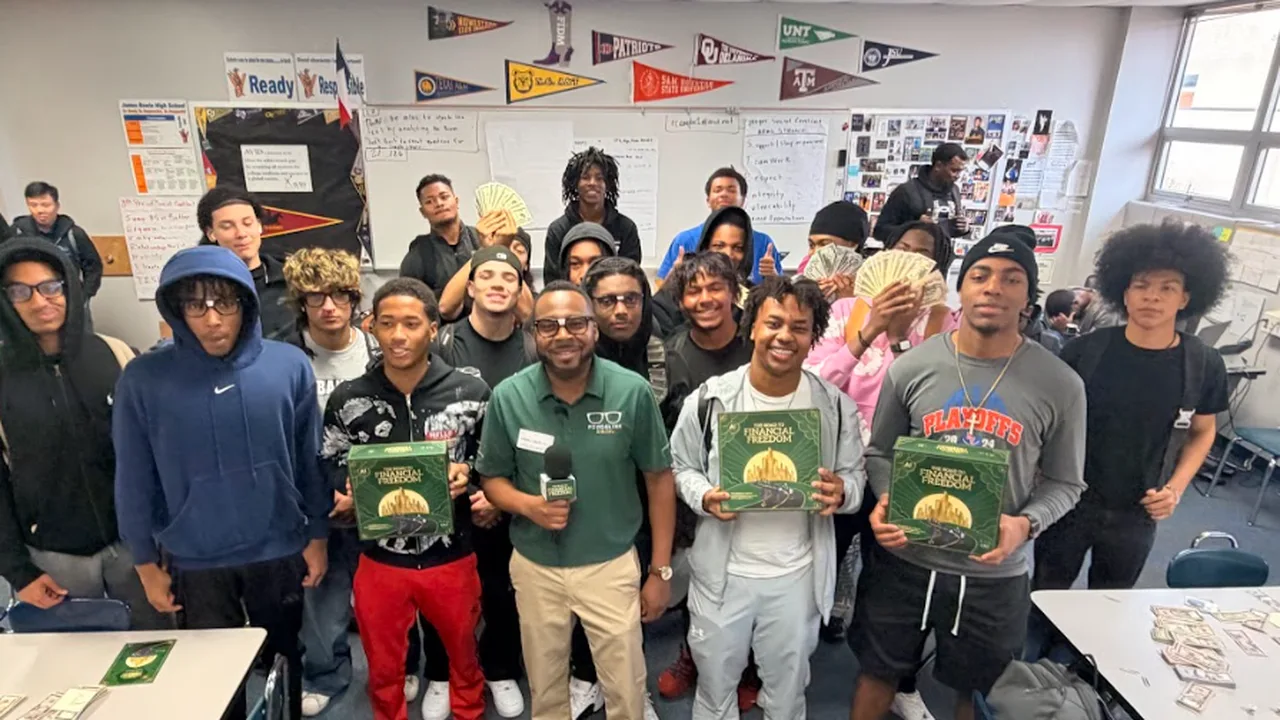
The optional board game gives students another way to practice money decisions together. It is sold separately, and every curriculum lesson and assessment works without it.
If money is a game, you need to know the rules of the game to win
A student sequence, a teacher layer, and transparent assessment materials. Each has a distinct role in the district review.
10 units and 43 lessons plus Capstone organized into a 21 week sequence, from money as a tool to a personal capstone plan.
Teacher Implementation Guides, lesson cards, slide decks, and answer keys support preparation and teacher led instruction.
Daily exit tickets and Money Checks, unit summatives with published rubrics, pre and post assessments on parallel forms, and a capstone ten year plan. Scoring is done by the teacher.
Spanish materials, autograding, and expanded accessible adaptations are planned and are not available today.
Expectation by expectation, the crosswalk documents what is addressed, partially addressed, and unaddressed. It is published in full in the District Review Package.
House Bill 27 (2025) replaced the one half credit economics requirement with a one half credit course in personal financial literacy. It applies to students who entered grade 9 in the 2026 to 2027 school year and later, beginning with the class of 2030. Students who entered grade 9 earlier keep the requirements in place when they started high school.
The amended graduation rule, 19 TAC §74.12, took effect. Districts meet the requirement today with §113.49 Personal Financial Literacy or §113.76 Personal Financial Literacy and Economics.
The State Board of Education adopted §113.26, Applied Personal Financial Literacy (one half credit), the new standards for this course.
TEA states that Applied Personal Financial Literacy will be implemented in classrooms beginning this year, replacing the current personal financial literacy courses for this requirement.
Every student in the class of 2030 and later completes a personal financial literacy course, so districts are planning for this course at full scale.
Courses taught now use §113.49 or §113.76. Classrooms move to §113.26 in 2028 to 2029. Materials chosen now should hold up through that change.
Board members, curriculum staff, social studies leaders, and principals each shape course offerings, materials, and staffing for the new requirement.
The Road to Financial Freedom® curriculum is crosswalked to the new §113.26 standards. Of 85 student expectations, 43 are addressed, 33 are partially addressed, and 9 are not addressed. These counts follow the proposed text TEA published on July 24, 2026 and are provisional until rechecked against the adopted text. The full crosswalk, gaps included, is in the District Review Package. Districts confirm the course code they use this year. No state approval is claimed.
Sources: Texas Education Agency, Updates to High School Social Studies and Personal Financial Literacy Graduation Requirements, September 17, 2026 and 19 TAC §74.12 as adopted June 26, 2026
Read the requirement above and the course overview at the front of the District Review Package.
Go to the Texas TEKS crosswalk, the scope and sequence, and the pacing in the package.
Review the 21 week pacing, what teachers receive, and how a pilot runs.
Read Unit 1 exactly as students and teachers receive it, with the assessments.
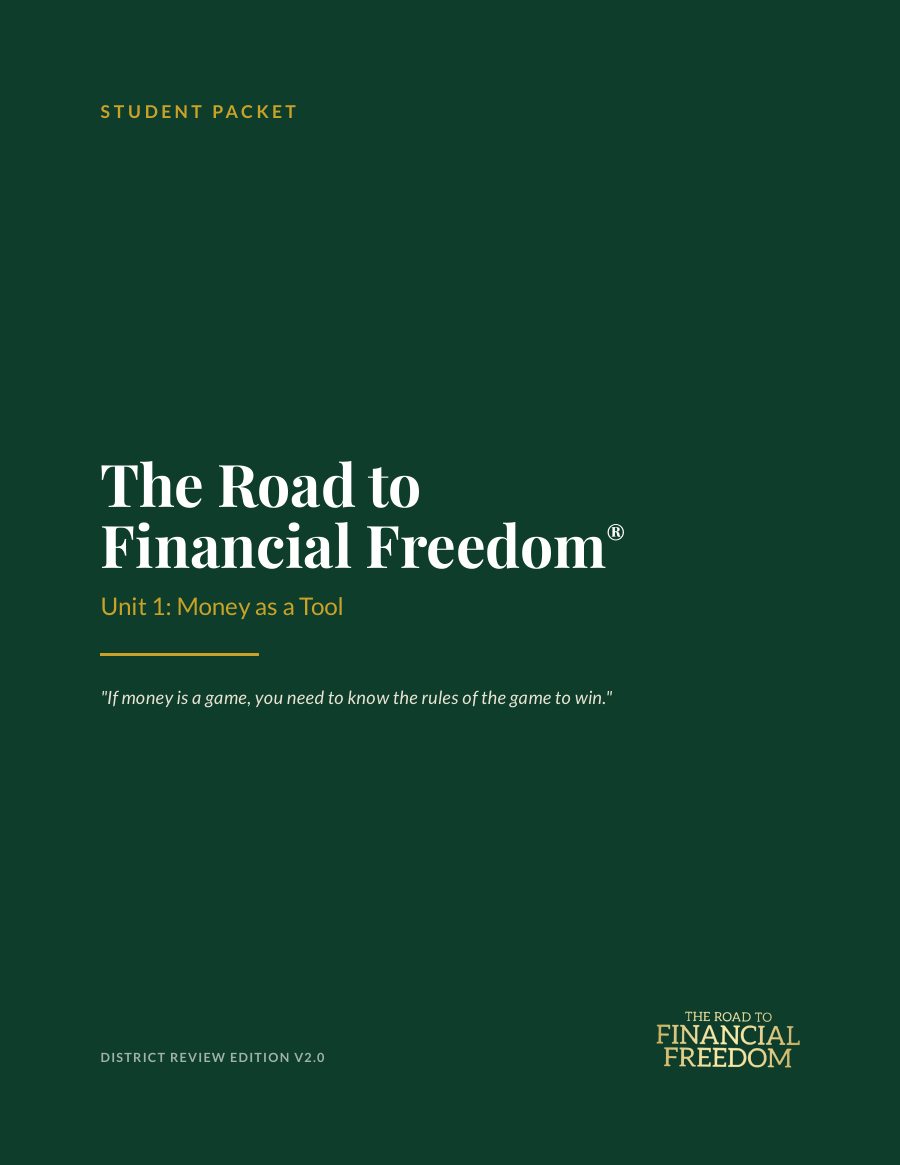
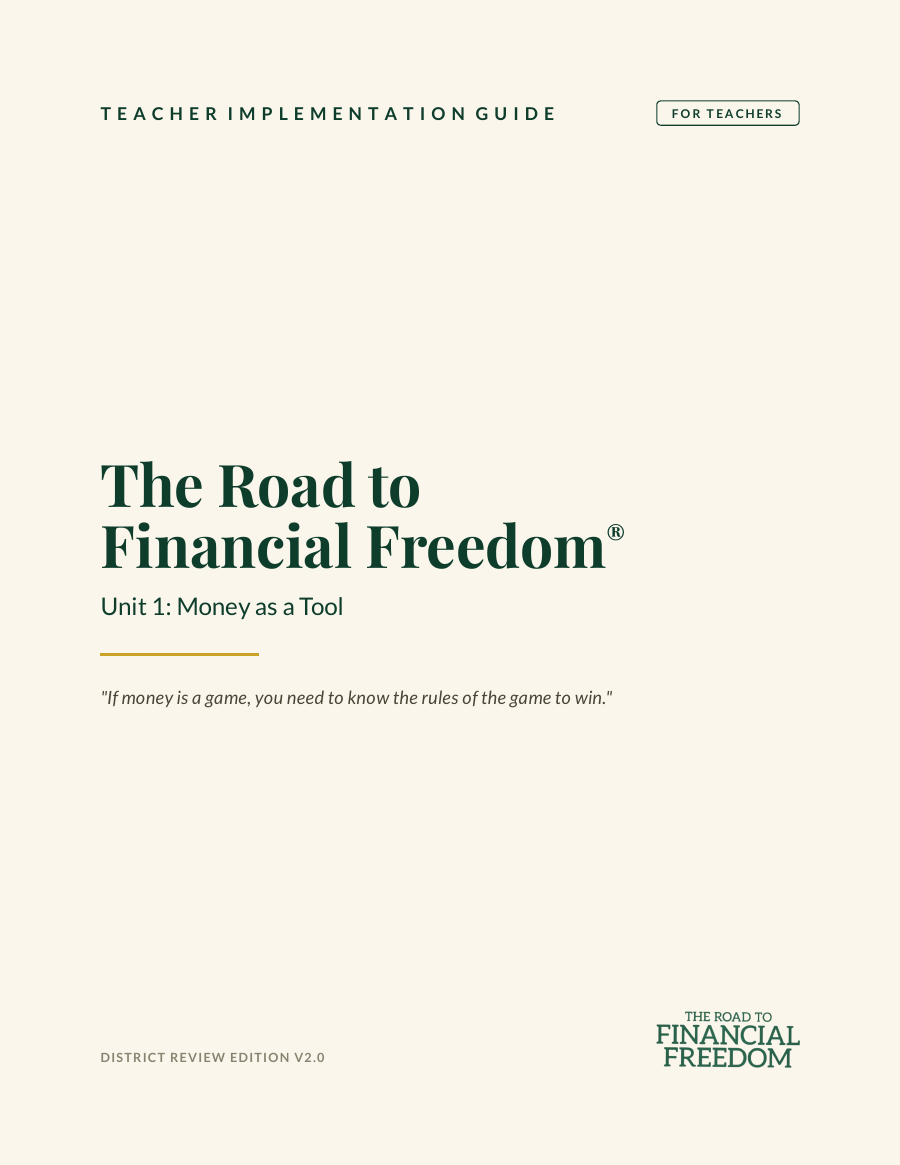
One PDF, 97 pages. This is a curated review set, not the full curriculum. It contains the overview, the pacing, the complete Texas TEKS crosswalk with its gaps published, Unit 1 exactly as teachers and students receive it, the Unit 1 paper quiz, the assessment instruments, and what running a campus implementation involves. Page 1 shows board members, curriculum directors, and principals or teachers where to start. The complete ten unit master is available on request.
Contact us for a quote. Classroom and student scope, timing, pricing, and terms are confirmed in a written proposal, not by this overview.
$495 annual program minimum, which covers up to 33 students.
Three year agreements are quoted separately.
The $495 license covers up to 33 students for one year. More than 33 students is $15 per student, by quote.
A digital pilot covers the classrooms, students, and period named in its signed agreement. The existing review package shows Unit 1 student and teacher materials, assessments, and implementation guidance. The optional physical board game is sold separately.
Purchase orders are an option for district purchasing. Purchase orders accepted. Payment terms confirmed before invoicing. Ask about your district’s requirements in the inquiry form. Our team confirms eligibility, vendor requirements, and payment terms in writing before invoicing. A purchase order authorizes a purchase; it is not payment or automatic approval.
The curated 97 page review PDF and its existing sample covers are available above. Assessments are teacher scored. Spanish materials, autograding, and expanded accessible adaptations remain planned and unavailable today.
Request a review, discuss a pilot, or ask about annual licensing. A person on our team reads your inquiry and replies by email.
10 units, 43 lessons plus Capstone across a 21 week sequence for grades 9 to 12.
The review package’s course overview describes one Student Packet per unit with handouts, worksheets, a Decision Journal, Life Navigation Lab, and Take It Home sheet.
The documented unit set includes a Teacher Implementation Guide, Answer and Facilitation Key, Assessment Package, and lesson slide deck with speaker notes. Course materials include lesson cards, pacing, and a glossary.
Exit tickets, Money Checks, unit summatives with rubrics, pre and post assessments, and a capstone ten year plan use teacher scoring. The course overview, scope and sequence, and Texas crosswalk are in the review PDF.
The 97 page District Review Package contains the course documentation, a full Unit 1 student sample, the Unit 1 paper quiz, its Teacher Implementation Guide and assessments, pre and post assessments, and a supplementary note on the optional board game. It is not the final complete ten unit curriculum delivery. The complete master is available to approved district reviewers on request; delivery scope is confirmed in writing.
Materials are delivered digitally. Your signed agreement defines copying for licensed classrooms and use within your district’s learning system. We do not print or ship curriculum materials. The optional board game is sold separately.
Publisher or distribution rights require a separate agreement reviewed by the founder. A district license does not include resale, publishing, or distribution outside the licensed district.
Pricing, rights, and terms are confirmed in writing by our team. This overview is not a quote or a commitment.
Your district’s vendor and purchase order requirements are confirmed before invoicing. Access begins under the payment or approved PO terms in your agreement.
Read the District Review Package and discuss educational fit with our team.
Confirm classrooms, students, timing, and terms in a signed agreement.
Use the sequence and teacher scored assessment materials during the pilot.
Discuss the class assessment summary and your teaching experience together.
Decide whether an annual district license is the right next step.

The Road to Financial Freedom® board game is a supplemental learning tool, sold separately. Every lesson, standard, and assessment works without it.
Districts can consider adding the game later. It is never required for the curriculum.
Review public sources on official requirements, applicable student cohorts and state guidance as a starting point for local adoption review. Resource crosswalks remain pending, apart from the existing partial Texas self-review. Public state facts do not establish state approval or confirmation that these resources meet every course or graduation requirement.
Colors describe review status, never approval. Forest green outlines mark state boundaries. A thick gold outline marks your selected state without changing its review status.
Map: US Atlas, U.S. Census Bureau 2017 boundaries, Albers projection with Alaska and Hawaii insets. ISC license.
Public source research
Partial Texas review
Full state crosswalk pending
Sources checked October 12, 2026
0.5 credit Personal Financial Literacy replaces the 0.5 economics graduation requirement for new grade 9 entrants; earlier cohorts retain their original requirements.
Cohort and effective dates: Grade 9 entrants 2026 to 2027 onward; June 2026 graduation rule amendments implement HB27 (2025). New Applied PFL TEKS adopted August and September 2026, classroom implementation 2028 to 2029.
The topic list summarizes existing personal finance standards; it does not summarize every benchmark in the replacement Applied Personal Financial Literacy standards.
Partial coverage of Texas Personal Financial Literacy TEKS §113.26, with §113.76 shown for cohorts still under the transition. The review crosswalk identifies addressed, partially addressed, and unaddressed expectations. No state approval is claimed.
Existing TEKS courses Personal Financial Literacy (§113.49) and Personal Financial Literacy and Economics (§113.76) are the current routes. New Applied Personal Financial Literacy (§113.26) will replace them for this graduation purpose in 2028 to 2029.
Personal financial literacy instruction for grades 9 to 12. The resource set contains 10 units and 43 lessons plus Capstone organized into a 21 week sequence. Districts review how it fits their instructional plan.
Materials are delivered digitally in the formats and access arrangements confirmed in your pilot or district agreement. Curriculum printing and shipping are not included.
Your signed agreement defines copying for licensed classrooms and use within your district’s learning system. Campus scope, student scope, and the license term are confirmed in writing. Public sharing, resale, and publishing rights require a separate agreement.
Yes. The curated 97 page District Review Package is on this page to view or download. The complete ten unit master is shared with approved district reviewers on request. Request a District Review.
A paid digital pilot is limited to the classrooms, student scope, and period stated in its agreement. An annual district license defines broader agreed campus and student use for its annual term. Pilot pricing and terms are confirmed individually.
No. The board game is an optional supplemental tool sold separately. The curriculum lessons and assessments work without it.
Crosswalked to Texas Personal Financial Literacy TEKS §113.26, which districts implement beginning with the 2028 to 2029 school year. Of 85 student expectations, 43 are addressed, 33 are partially addressed, and 9 are not addressed. These counts follow the proposed text TEA published on July 24, 2026 and are provisional until rechecked against the adopted text. The complete crosswalk is published in the District Review Package on this page. Until §113.26 is implemented, districts teach this course under §113.49 or §113.76, so districts confirm the applicable course code. No state approval is claimed.
Yes. State standards and course requirements vary, so alignment must be reviewed against your state’s requirements before adoption.
Our team confirms your district’s vendor and PO requirements before invoicing. Access begins under the payment or approved PO terms in the signed agreement. A purchase order authorizes a purchase; it is not itself payment.
Every unit includes a two page paper quiz with a teacher key, given before and after the unit, plus a written Money Check scored with a rubric. Teachers score these by hand. Digital quizzes are in a limited pilot and are not part of the standard package yet.
Curriculum licensing is $15 per student for one year, with a $495 annual program minimum that covers up to 33 students. Three year agreements are quoted separately. Scope, license term, and terms are confirmed in a written proposal. Use the inquiry button to discuss a review, pilot, or annual license.