
For Families
A Family Money Game That Teaches Kids and Teens the Rules of Money
The Road to Financial Freedom® turns family game night into a real conversation about money. Ages 12 and up make decisions about credit, debt, investing, and real estate on every turn — and the whole family learns together without a lecture.
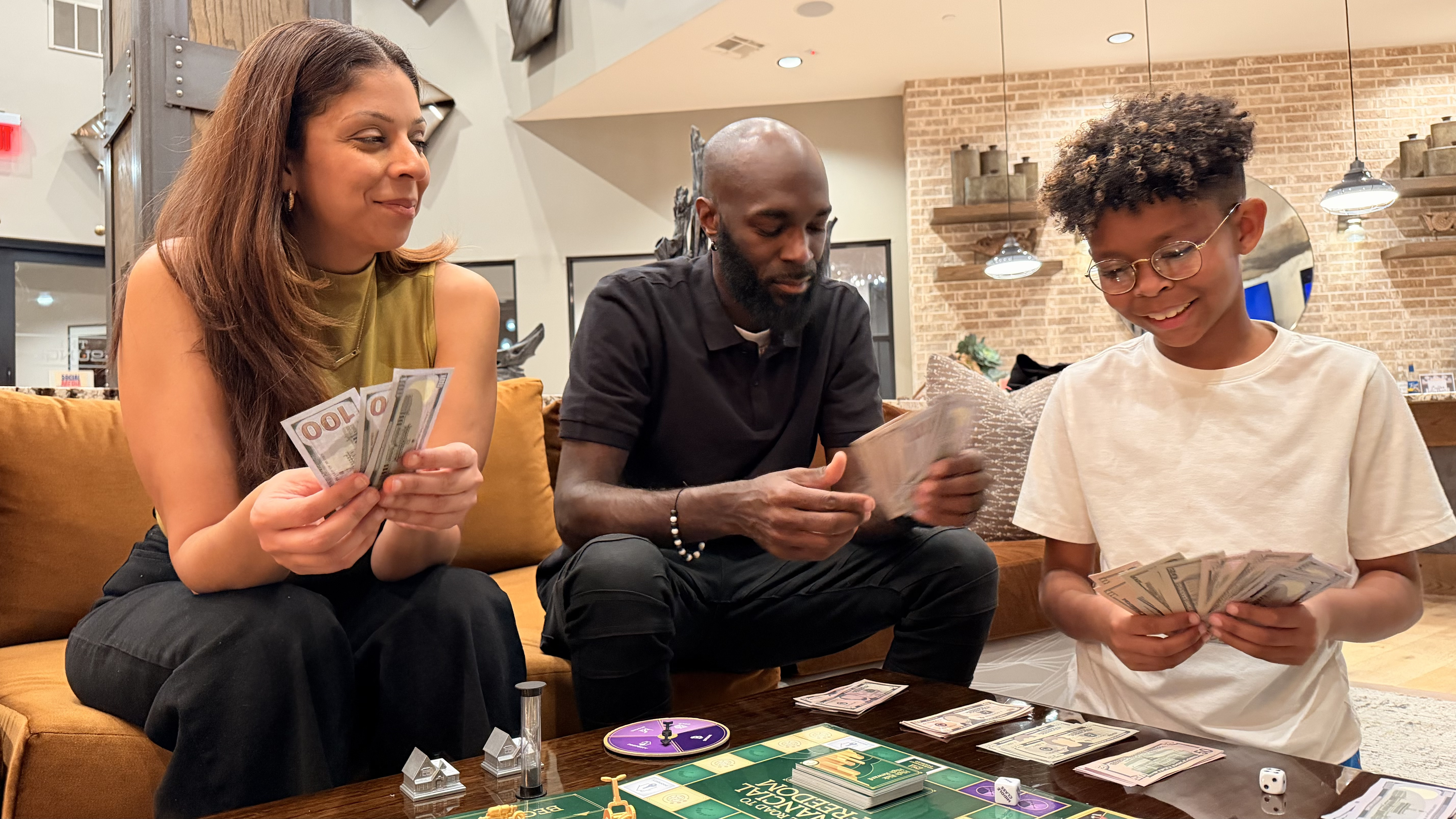
Quick family facts
- Ages
- 12 and up
- Players
- 2 to 10
- Play time
- 45 to 60 minutes
- Format
- Physical board game
Why Families Play It
Money conversations happen naturally when everyone is making decisions together.
Start real money conversations
The game gives everyone at the table a shared situation to react to, so the talk about credit, debt, and investing happens naturally.
Learn by doing, not lecturing
Players make the decision themselves, see the consequence, and then adjust. Parents do not have to play the role of finance teacher.
One game, multiple generations
Teens, parents, and grandparents can sit down together and all be challenged. The decisions are the same; the conversations are different.
Built for repeated play
No two games play out the same way, so families keep coming back to try new strategies and talk through different outcomes.
What age should kids start learning about money?
The game is designed for ages 12 and up.
That is the age when money decisions start becoming real: a first job, a first car, a phone bill, or a savings goal. Younger children can play alongside a parent or older sibling. The questions in the game are the same ones families will face in real life, so the conversation keeps going after the box is closed.
Will my teen actually enjoy it?
Yes — it plays like a real game night.
There are dice, money, big swings, and surprises. The difference is that every decision teaches something useful. Teens stay engaged because they are competing, negotiating, and reacting to what just happened to them. Most groups ask to play again immediately.
What will they learn?
Players learn how money decisions compound over time by experiencing the consequences at the table.
Budgeting
Players decide how to allocate the money they have while bills and opportunities keep arriving.
Saving
Setting money aside competes with spending and investing on every turn, so the trade off is visible instead of abstract.
Credit
Cards put players in front of credit decisions and let them see how those choices follow them through the rest of the game.
Debt
Borrowing solves an immediate problem and creates a later one. Players feel the difference between productive and costly debt.
Investing
Players weigh investments against safer options and watch how those choices play out over the length of the game.
Real estate
Property decisions show how an asset can generate value and how it ties up money at the same time.
Risk and reward
Some spaces offer upside with exposure attached. Players practice sizing a risk rather than defining the word.
Financial decision making
Every turn is a decision with a consequence at the table, which is where the real learning happens.
What do families talk about after the game?
The debrief is where the game turns into a lesson.
These prompts work with any family group:
- What decision helped you the most?
- What decision hurt you financially?
- What surprised you?
- How did debt affect your progress?
- How did investing change your outcome?
- What would you do differently next time?
These are discussion prompts, not claims about guaranteed learning outcomes.
Can homeschool and co-op groups use it?
Yes. The game works well as a homeschool financial literacy activity or co-op lesson.
One game handles 2 to 10 players, so a single homeschool family or a small co-op group can play together. Families often use it alongside a personal finance, life skills, or economics curriculum because the decisions in the game match the concepts in those lessons.
How can families use it?
- Friday or weekend family game nights
- Conversations about money your teen will actually join
- Homeschool and co-op financial literacy lessons
- Multi-generational gatherings
- Preparing older kids for their first job, car, or apartment
Bring it home
Choose the single game for family game night or the Family 2-Pack to keep one and gift one.
Single game
One game for 2 to 10 players. Perfect for family game night.
Family 2-Pack
Two games to keep one and gift one, or for larger family gatherings.
Family questions
What age is the game for?
The Road to Financial Freedom® is designed for ages 12 and up. Tweens, teens, parents, grandparents, students, and professionals can all play at the same table. Younger children can play with a parent.
How many people can play one game?
One game supports 2 to 10 players. A family of four has plenty of room, and a larger gathering can split into two games.
How long does a game take?
A full round takes about 45 to 60 minutes. Smaller families finish closer to 45 minutes; first-time players usually take a little longer.
Will my teenager actually enjoy it?
Yes. The game plays like a real game night — dice, money, decisions, and surprises — while the money lessons land through the choices, not a lecture. Most groups ask to play again.
What money topics does the game cover?
Saving, budgeting, credit, debt, investing, real estate, taxes, insurance, careers, emergency expenses, risk and reward, and financial decision making.
Do parents need a finance background to play?
No. If you can read at a fifth-grade level, you can play. Harriet, the optional digital guide, explains any card in plain language with no app install and no account required.
Is this a board game or an app?
It is a physical board game, not a mobile app or video game. Harriet is an optional digital guide that explains cards when you want extra help.
Can homeschool or co-op groups use it?
Yes. The game works well as a homeschool financial literacy activity or co-op lesson. One game handles 2 to 10 players, and families often use it alongside a personal finance or life-skills curriculum.
What comes in the box?
The game includes the board, cards, dice, player pieces, and play money needed for a full game. Harriet is available as an optional digital guide.
What do families talk about after the game?
Families usually discuss which decisions helped or hurt, what surprised them, and what they would do differently. Those conversations are where the game turns into real learning.
Keep reading
- How to play The Road to Financial Freedom, turn by turn
- Buy The Road to Financial Freedom board game
- Schools, districts and organizations: packages, quotes and purchase orders
- Request bulk pricing for 11 or more games
- Read verified customer reviews of the game
- About the game and its founder, Bostic Poindexter